SQL vs NoSQL Databases: Key Differences, Use Cases, and When to Use Each
This blog explains the key differences between SQL and NoSQL databases, including their architecture, scalability, performance, and real-world use cases. It helps developers understand when to use relational databases like MySQL and PostgreSQL versus NoSQL databases like MongoDB and Redis in modern full-stack web development.
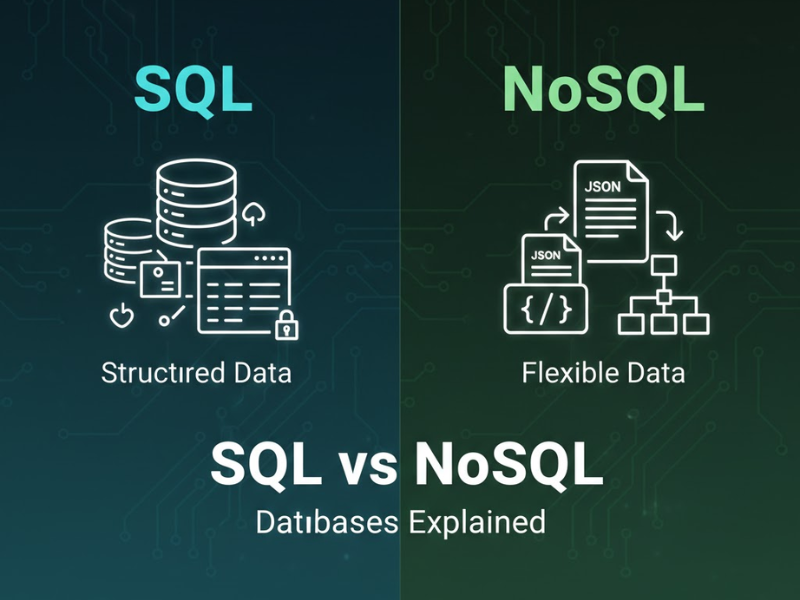
In modern web development, databases play a critical role in application performance, scalability, and data integrity. As a full-stack web developer, understanding the difference between SQL and NoSQL databases is essential for building scalable, high-performance web applications.
This blog explains SQL vs NoSQL databases, their architecture, advantages, disadvantages, and real-world use cases.
What Is an SQL Database?
An SQL database (Structured Query Language database) is a relational database that stores data in tables with rows and columns. SQL databases follow a fixed schema and use ACID properties (Atomicity, Consistency, Isolation, Durability) to ensure data accuracy and reliability.
Popular SQL Databases
-
MySQL
-
PostgreSQL
-
Microsoft SQL Server
-
Oracle Database
Key Features of SQL Databases
-
Structured data storage
-
Predefined schema
-
Strong data consistency
-
ACID compliance
-
Complex queries using SQL
-
Relational data modeling
Advantages of SQL Databases
-
Excellent for transaction-based applications
-
Strong data integrity
-
Ideal for financial systems, ERP, and CRM
-
Easy to perform JOIN operations
-
Mature ecosystem and tools
Disadvantages of SQL Databases
-
Vertical scalability limitations
-
Schema changes can be complex
-
Less flexible for unstructured data
What Is a NoSQL Database?
A NoSQL database (Not Only SQL database) is a non-relational database designed to handle large-scale, distributed, and unstructured data. NoSQL databases offer schema flexibility and are optimized for horizontal scalability.
Types of NoSQL Databases
-
Document-based: MongoDB, CouchDB
-
Key-Value stores: Redis, DynamoDB
-
Column-based: Cassandra, HBase
-
Graph databases: Neo4j
Key Features of NoSQL Databases
-
Schema-less or dynamic schema
-
High scalability and availability
-
Optimized for big data and real-time applications
-
Distributed architecture
-
BASE consistency model
Advantages of NoSQL Databases
-
High performance at scale
-
Flexible data models
-
Easy horizontal scaling
-
Suitable for real-time and big data applications
-
Faster development cycles
Disadvantages of NoSQL Databases
-
Weaker consistency in some cases
-
Limited complex query support
-
Less standardized compared to SQL
SQL vs NoSQL: Core Differences
| Feature | SQL Database | NoSQL Database |
|---|---|---|
| Data Model | Relational | Non-relational |
| Schema | Fixed | Dynamic |
| Scalability | Vertical | Horizontal |
| Consistency | ACID | BASE |
| Query Language | SQL | Database-specific |
| Best For | Transactions | Big data & real-time apps |
When to Use SQL Databases
Use SQL databases when:
-
Data consistency is critical
-
You need complex queries and joins
-
Working with structured data
-
Building banking, accounting, or enterprise applications
-
Data relationships are important
When to Use NoSQL Databases
Use NoSQL databases when:
-
Handling massive data volumes
-
Building real-time applications
-
Working with semi-structured or unstructured data
-
Scaling horizontally across servers
-
Developing microservices-based architectures
SQL and NoSQL in Full Stack Development
In real-world full-stack development, SQL and NoSQL databases often work together.
Examples:
-
SQL database for user authentication and payments
-
NoSQL database for caching, logging, and analytics
Choosing the right database depends on:
-
Application requirements
-
Scalability needs
-
Data structure
-
Performance goals